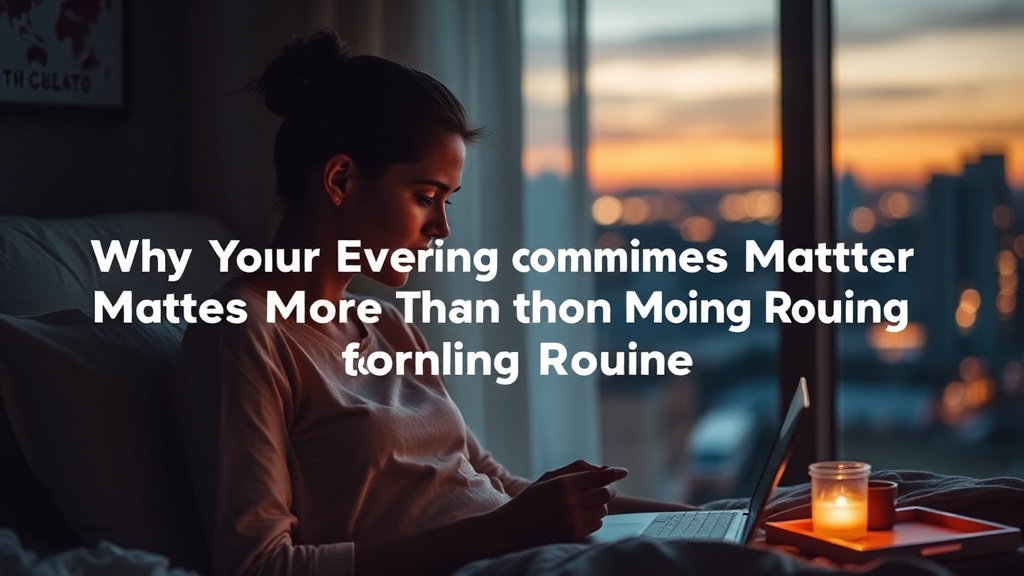
Why Your Evening Routine Matters More Than Your Morning Routine

We've been sold a myth—that the key to a productive, balanced life lies in waking up at 5 AM, chugging lemon water, and completing a twenty-step morning ritual before the rest of the world stirs. But here's what nobody's talking about: your morning is only as good as the night before. A chaotic, screen-saturated evening practically guarantees a sluggish, scattered morning—no matter how many cold showers you endure.
This guide isn't about adding more tasks to your already full plate. It's about reclaiming the final hours of your day as a buffer between the chaos of modern life and the rest your body actually needs. You'll learn how to build an evening routine that supports better sleep, reduces decision fatigue, and creates a gentle transition into the next day—without requiring two hours of free time or expensive gadgets.
What Should I Do Two Hours Before Bed to Sleep Better?
The two-hour window before sleep is when your brain begins transitioning from active mode to rest mode—if you let it. Most of us sabotage this process without realizing it. That "quick" email check at 10 PM? It triggers a cortisol spike that can take 90 minutes to settle. That intense true-crime documentary? Your sympathetic nervous system doesn't know the threat isn't real.
Start by creating what sleep researchers call a "stimulus control boundary." This means the bedroom (or at least the bed) becomes associated with only two activities: sleep and sex. Everything else—work, scrolling, worrying—gets pushed outside that space. It's not about perfection; it's about probability. The more consistently you reinforce this boundary, the faster your brain learns to switch gears.
Dim the lights progressively as evening advances. Bright, blue-enriched light suppresses melatonin production, tricking your brain into thinking it's still daytime. You don't need special bulbs or fancy lamps—just switch off overhead lights and use lamps with warm-toned bulbs instead. Even candlelight (safely managed, of course) sends a powerful signal to your circadian rhythm that night has arrived.
Consider adopting a "digital sunset"—a specific time when screens go away. Research from the National Sleep Foundation confirms what many of us feel intuitively: blue light exposure delays melatonin release and fragments sleep architecture. If going completely dark feels impossible, start with 30 minutes. Use that time for analog activities: reading paper books, gentle stretching, or conversation with household members.
How Do I Stop Overthinking at Night?
The witching hour for anxiety is unmistakably post-9 PM. As the day's distractions fade, your brain—finally getting your attention—dumps every unresolved worry, tomorrow's to-do list, and random observation onto your mental stage. Suddenly you're rehearsing conversations from 2019 and calculating whether you paid the internet bill.
The brain dump technique works because it externalizes what's bouncing around your skull. Keep a notebook specifically for evening use—not your phone, not your work laptop, but an actual paper notebook. Spend five minutes writing down every thought, task, or concern that surfaces. Don't organize it. Don't prioritize it. Just get it out. Your brain stops holding onto information it perceives as "handled"—even if handling just means writing it down.
Another approach is scheduled worry time. Sounds counterintuitive, but it works. Set aside 15 minutes earlier in the evening—say, right after dinner—to actively think through concerns and plan responses. When worries pop up later, you can tell yourself (and mean it): "I've already addressed that today." This technique, backed by cognitive behavioral therapy research, trains your brain to respect boundaries around rumination.
For persistent mental chatter, try a body scan practice. Lie down and systematically bring attention to each part of your body, starting at your toes and moving upward. Not to relax per se—though that often happens—but to give your brain a specific, neutral task that occupies its pattern-matching tendencies without generating new thoughts. Apps like Insight Timer offer free guided options, but you can also do this silently once you learn the sequence.
Can a Simple Evening Routine Really Change My Life?
Let's be realistic—no evening routine will transform you into a morning person if you're genetically predisposed to night owl tendencies. Chronotype is partially heritable, and fighting your biology is a recipe for frustration. What a thoughtful evening routine can do is maximize the sleep quality you do get, reduce the friction of morning transitions, and create psychological closure on the day.
Think of it as bookending your day. Just as a morning routine sets intentions, an evening routine provides integration—a chance to process what happened, reset your environment, and prepare your future self for success. This isn't about optimization in the Silicon Valley sense. It's about basic self-respect: acknowledging that rest is not the absence of productivity but a prerequisite for it.
The compounding effect is where the real magic lives. One good night's sleep improves mood regulation, decision-making, and impulse control. String together several nights and you notice the difference in energy, creativity, and even relationships. You're less reactive. More present. Better able to handle the inevitable friction of daily life.
Building Your Personal Evening Ritual
There's no universal template—your ideal routine depends on your schedule, living situation, and what genuinely soothes you (not what wellness influencers claim should soothe you). Start with these foundational elements and customize:
- Environmental reset: Tidy your primary living spaces. Not deep cleaning—just returning things to their designated homes. A clear space signals a clear mind.
- Preparation for tomorrow: Lay out clothes, pack bags, prep breakfast components. Decision-making depletes willpower; front-load it when you're fresh.
- Sensory transition: Change into "evening clothes" that feel different from day clothes. Light a specific candle or diffuse a particular scent. These sensory cues train your nervous system.
- Connection ritual: Brief, device-free interaction with people you live with—or yourself. A real conversation, a shared cup of tea, a moment of gratitude journaling.
Pick one element to start. Master it for a week before adding another. Sustainable routines are built through incremental layering, not wholesale adoption.
Why Do I Feel Wired When I'm Exhausted?
You're lying in bed, eyelids heavy, body aching for rest—and yet your mind races like you've mainlined espresso. This phenomenon—tired but wired—is one of the most frustrating aspects of modern life. It happens when your sympathetic nervous system (fight or flight) remains activated while your body craves parasympathetic dominance (rest and digest).
Caffeine is an obvious culprit with a half-life of 5-6 hours. That 3 PM coffee is still circulating at 9 PM. But less obvious triggers include late-night intense exercise, heated arguments, stimulating entertainment, and even certain supplements. Pay attention to your personal patterns—some people metabolize caffeine faster than others, and genetic testing can actually reveal your sensitivity.
The solution isn't always elimination but timing. Move vigorous workouts to earlier in the day. Have difficult conversations before dinner. If you're genuinely hungry before bed, choose complex carbohydrates with a small amount of protein—a banana with almond butter, for example—which can help tryptophan cross the blood-brain barrier and support melatonin synthesis.
When you do find yourself wired despite exhaustion, don't fight it. Paradoxical intention—staying awake on purpose—often triggers sleep faster than desperate attempts to force it. Get up, do something mildly engaging in dim light (folding laundry, organizing a drawer), and return to bed only when sleepiness returns. Lying awake in bed trains your brain to associate that space with wakefulness—the opposite of what you want.
Honoring Your Natural Rhythms
The obsession with morning productivity has created a culture of sleep shame—where needing more than six hours or not bouncing out of bed at dawn is somehow a moral failing. This is nonsense. Sleep needs vary significantly between individuals, and research published in Nature Human Behaviour suggests that consistent schedules matter more than specific timing.
What's non-negotiable isn't when you sleep but that you protect sleep as the biological necessity it is. Chronic sleep deprivation increases risk for cardiovascular disease, impairs glucose metabolism, compromises immune function, and degrades emotional regulation. In other words, skipping sleep to get more done is a false economy—you're borrowing from tomorrow's effectiveness to fund today's overextension.
Your evening routine is the container that holds your sleep. Design it with the same intention you'd bring to any other important relationship—because that's exactly what it is. The relationship between your waking self and your resting self deserves respect, boundaries, and regular tending.
"Sleep is the single most effective thing we can do to reset our brain and body health each day." — Dr. Matthew Walker, Why We Sleep
Start tonight. Not with a complete overhaul, but with one small act of evening self-care. Your morning self—the one who actually has to live through tomorrow—will thank you for it.